




Introduction
Training can require a significant investment of time, money, and organisational resources. Yet completing a course does not automatically mean employees have developed useful skills, changed how they work, or contributed to better business outcomes.
Positive feedback forms can tell you whether participants enjoyed a programme, but they provide only one part of the picture. To understand whether training has made a meaningful difference, we advise organisations to examine what participants learnt, what they applied at work, and whether those changes contributed to the intended results.
The Kirkpatrick Model provides a structured way to evaluate this progression through four connected levels: Reaction, Learning, Behaviour, and Results. For us as trainers, the model helps us ask better questions before, during, and after training so learning connects to what people are expected to do differently at work.
Key Takeaways:
- The Kirkpatrick Model evaluates training through four levels: Reaction, Learning, Behaviour, and Results.
- Positive learner satisfaction is useful, but it does not prove that participants developed new capabilities or applied them at work.
- Training evaluation should begin with the intended organisational result and the workplace behaviours needed to support it.
- Level 3 is particularly important for practical skills because employees need opportunities, support, and reinforcement to transfer learning into their daily work.
- Effective evaluation combines participant feedback, assessments, workplace observations, manager input, and performance data to identify where training is working and where further support is needed.
What the Kirkpatrick Model Helps Us Evaluate
The Kirkpatrick Model helps us assess whether participants found the training relevant, what they learnt, and whether they applied those skills at work. Looking across these four areas gives us a more complete view of training effectiveness than course completion or participant feedback alone.
Historical Context and Development
The Kirkpatrick Model was developed by Donald Kirkpatrick in the 1950s while he was working on evaluating management development programmes. Its four-level structure subsequently became one of the most widely recognised approaches to training evaluation.
The model has continued to evolve. The current framework retains Reaction, Learning, Behaviour, and Results while placing greater emphasis on working backwards from the desired organisational outcome, supporting workplace application, and considering the environment in which employees are expected to perform.
As trainers, we may see participants understand and demonstrate a technique successfully during a workshop, but that does not guarantee they will use it consistently at work. Manager support, existing processes, opportunities to practise, and workplace expectations can all affect whether they apply what they learn.
The Four Levels of Evaluation
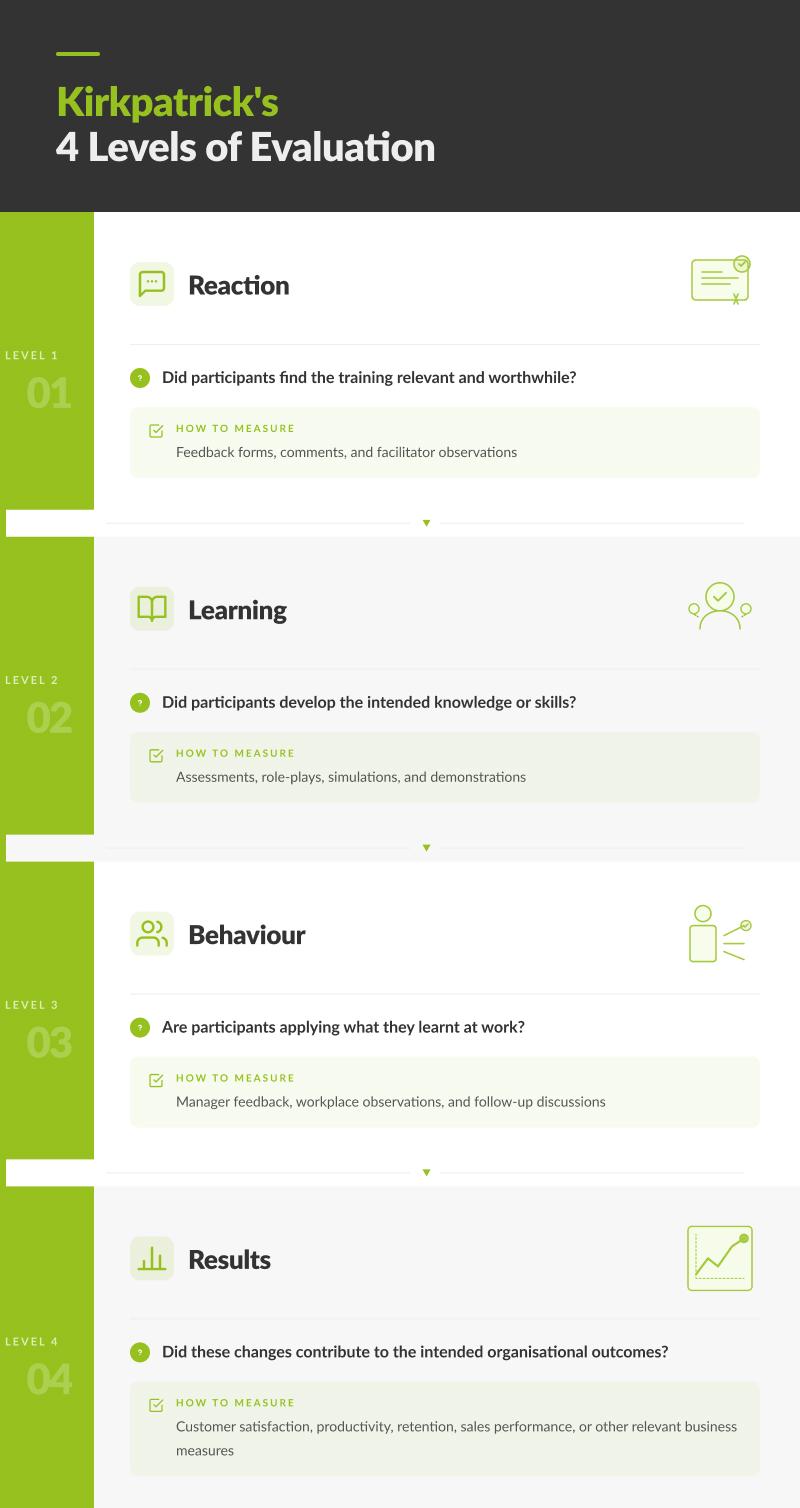
The four levels of the Kirkpatrick Model examine different questions: How did participants respond? What did they learn? What changed at work? What results followed? Keeping those questions separate helps prevent one type of evidence from being mistaken for another.
Level 1: Reaction
Level 1 considers how participants respond to the training experience. This includes whether they find the programme relevant, engaging, worthwhile, and applicable to their roles.
Common evaluation areas include:
- Satisfaction with the programme
- Engagement during activities
- Relevance to the learner’s role
- Clarity of the training materials
- Confidence in applying the content
While the Kirkpatrick Model helps explain the learner experience, it should not be the final verdict on training effectiveness.
Feedback forms are useful here, but we also pay attention to participant comments, questions, engagement during exercises, and facilitator observations. These can reveal whether the programme is connecting with the situations participants actually face.
A positive reaction is not proof that meaningful learning occurred. We have seen how an energetic activity can be highly enjoyable without necessarily challenging participants to develop a new capability. Conversely, a demanding role-play may feel uncomfortable precisely because it exposes a skill gap the participant needs to work on.
Level 2: Learning
Level 2 examines whether participants developed the knowledge, skills, attitudes, confidence, or commitment that the programme was designed to build.
Possible outcomes include:
- Greater understanding of a subject
- Improved practical ability
- Increased confidence in performing a task
- Changes in attitudes or perspectives
- Stronger commitment to applying a new approach
How we evaluate this depends heavily on what we train. A knowledge-based programme may use assessments or case questions to examine knowledge acquisition. For soft skill training, however, knowing the correct answer on paper tells us relatively little about whether someone can perform under pressure.
For example, in conflict management, we may use a simulated disagreement to observe how participants listen, acknowledge concerns, and respond under pressure. Comparing their performance before and after training helps us identify whether these skills have actually improved.

Level 3: Behaviour
Level 3 looks at what participants do differently once they return to work. We evaluate whether the skills practised during training appear in everyday situations, providing evidence of real-world application beyond the classroom.
Changes might include:
- Managers giving clearer feedback
- Employees handling disagreements more constructively
- Salespeople asking stronger discovery questions
- Customer-facing employees responding with greater empathy
- Team members collaborating more effectively
Workplace conditions can affect whether participants apply what they have learnt. For example, a manager may practise giving constructive feedback successfully during training but have few opportunities or little support to continue the practice at work.
This level of the Kirkpatrick Model evaluates whether participants demonstrate behavioural change after returning to work. Evidence can come from manager observations, follow-up discussions, and workplace examples. For instance, after communication skills training, our trainers may look at whether participants communicate differently during meetings, feedback conversations, or stakeholder interactions.
Level 4: Results
At Level 4, we look beyond what participants gained from the programme and consider whether those improvements contributed to the organisation’s original goals. For leadership training, this could mean examining manager communication, employee engagement, or retention depending on why the programme was introduced.
Depending on the programme, these may include:
- Higher customer satisfaction
- Increased productivity
- Stronger employee retention
- Reduced workplace errors
- Improved sales performance
- Fewer safety incidents
- Better team engagement
- Faster onboarding and time to competence
The Kirkpatrick Model encourages organisations to connect evaluation to relevant indicators of organisational performance. We are also careful about attribution.
Sales figures, retention, productivity, and customer satisfaction can change because of staffing, market conditions, technology, management decisions, incentives, or other initiatives happening at the same time. Training may contribute to a result without being its sole cause.
How the Kirkpatrick Model Works in Practice
The four levels of the Kirkpatrick Model are more useful when examined together. A pattern across the evidence can show both whether training is working and where the transfer from learning to performance is breaking down.
Consider a customer service programme. Participants may rate the programme highly at Level 1 and demonstrate stronger questioning and service-recovery skills during simulations at Level 2. Several weeks later, managers can observe whether those behaviours appear during actual customer interactions at Level 3. Changes in complaint resolution, customer satisfaction, or repeat issues can then contribute to Level 4 evaluation.
Now assume a different outcome: participants perform strongly during the workshop, but managers see little change afterwards.
A gap between Level 2 learning and Level 3 behaviour can help identify why new skills are not being applied at work. If participants perform well during training but show little change afterwards, the issue may be limited practice opportunities, unclear expectations, limited manager support, or other workplace conditions. For soft skills training and development, this can show whether participants need more practice, coaching, or workplace reinforcement after the programme.

Our Advice on Putting the Kirkpatrick Model Into Practice
When planning a programme, we first clarify what the organisation wants to improve and what employees would need to do differently to support that goal. From there, we can identify the skills to develop and the evidence needed to evaluate whether those changes take place.
How to Implement the Kirkpatrick Model
A common mistake is designing the course first and deciding how to measure it afterwards. A stronger use of the model begins with the intended outcome and works backwards towards the learning experience.
1. Define the Intended Organisational Result
Before selecting training content, you should be clear about the business issue you want the programme to address. From a training perspective, this gives the programme a clear purpose and helps ensure the learning objectives connect to an actual workplace need.
For example, a customer service programme might be structured around:
- Result: Higher customer satisfaction
- Behaviour: More attentive listening and effective problem-solving
- Learning: Stronger questioning, empathy, and service-recovery skills
- Reaction: A relevant programme participants feel able to apply
This shifts the training conversation from the topics to cover to the behaviours employees need to demonstrate at work. From there, you can build learning objectives around those behaviours and the results the organisation wants to support.
2. Set Measures for Each Kirkpatrick Level
The evidence should match the change being evaluated. Participant feedback can tell us whether the training felt relevant, while assessments, workplace observations, and performance data show whether learning progressed beyond the training room.
- Reaction: Feedback on relevance, engagement, and confidence in applying the learning.
- Learning: Assessments, demonstrations, simulations, or role-plays.
- Behaviour: Evidence that participants use the intended skills at work.
- Results: Business indicators connected to the original goal.
Timing should match what you are measuring in your team. Drawing on our training experience, reaction can be assessed during or immediately after training, while behaviour and organisational results may take weeks or months to emerge. We advise planning these measurement points before the programme begins.
3. Gather Evidence from Multiple Sources
We avoid relying on a single measure when evaluating training because strong results in one area may not carry through to another. Combining useful evidence helps reveal where progress is occurring and where gaps remain:
- Participant feedback
- Knowledge assessments
- Role-play observations
- Manager interviews
- Customer feedback
- Workplace performance data
- Follow-up discussions
For example, after sales training, participant feedback may show whether the programme felt relevant, while role-plays can demonstrate improvements in questioning skills. We then guide managers to observe whether those questions are used in customer conversations, with pipeline or conversion data providing evidence of wider performance changes.
Multiple sources can also reveal individual development needs. In personalised learning, one participant may need more practice with questioning, while another may need support with listening or objection handling. This allows follow-up development to focus on the specific skills each person needs to strengthen.
4. Identify Barriers to Workplace Application
When participants can demonstrate a skill during training but do not use it at work, we look beyond the programme itself. We consider whether they have opportunities to practise, whether managers reinforce the expected behaviour, and whether existing processes or performance targets make the new approach practical.
For example, participants in consultative sales training may learn to spend more time understanding a prospect’s needs. If they return to a team measured mainly by call volume, shorter, product-led conversations may still be encouraged. In this situation, further training alone is unlikely to address the barrier. We advise reviewing how the desired sales behaviour is supported at work.
5. Use the Findings to Improve Future Training
Evaluation findings should guide the next step. They may point to changes in the training itself or to additional workplace support once participants return to their roles.
Evidence across the four levels may indicate changes in:
- Course content
- Case studies
- Practice activities
- Facilitation methods
- Workplace follow-up
- Manager support
- Performance resources
Using the Kirkpatrick Model as an ongoing cycle gives you clearer evidence of where your training investment is working and where changes are needed. For business owners and team leaders, this means you can see whether the issue lies in the programme itself, the support employees receive afterwards, or the workplace conditions affecting how new skills are applied.

Measuring the Impact of Training Programmes
Measuring impact requires more than collecting additional data. The evidence needs to answer the right questions at the right stage of the programme. We often look for a combination of measurable outcomes and context that explains why those outcomes occurred.
1. Combining Quantitative and Qualitative Evidence
We look at quantitative and qualitative evidence together because they often reveal different parts of the training outcome. Assessment scores, productivity, sales performance, or customer satisfaction can show where results have changed, while feedback from managers and participants helps us understand what may be driving those changes.
For example, strong post-training assessment scores may show that participants developed the intended skills, but manager feedback several weeks later may reveal that they are not applying those skills consistently. For soft skills such as communication, leadership, and negotiation, these workplace observations can identify progress or barriers that may not yet show up in broader performance data.
2. Choosing Suitable Evaluation Methods
Different stages call for different evaluation tools.
- Surveys and feedback forms: Assess relevance, engagement, confidence, and satisfaction.
- Knowledge tests and practical assessments: Examine whether participants developed the intended capabilities.
- Interviews and focus groups: Explore experiences, challenges, and workplace application.
- Manager observations: Identify whether new behaviours appear in everyday work.
- Performance data: Track changes in quality, productivity, customer outcomes, sales, or other relevant indicators.
Through our practical sales coaching programme, you may benefit more from reviewing actual conversations, manager observations, and changes in opportunity progression than from relying heavily on a written knowledge test.
3. Planning Evaluation from the Beginning
Evaluation is more effective when it is planned before training begins. We recommend establishing the intended outcome, a baseline, and the behaviours to observe early so there is something meaningful to compare against after the programme.
For a leadership programme, this may cover assessing capabilities before training, observing participants during practical exercises, and asking managers to monitor specific behaviours afterwards. Relevant team indicators can then be reviewed over time, making the Kirkpatrick Model a clearer evidence base for evaluating change.
Why Training Evaluation Matters to Participants
Training evaluation should not benefit only HR or management. When designed properly, it also gives participants clearer expectations, more useful feedback, and better support when they return to work.
Participants can benefit through:
- Clearer learning goals: They know which capabilities they are expected to develop.
- Greater workplace relevance: Activities connect more directly with situations they actually encounter.
- Useful feedback: Assessments and observations reveal specific strengths and development areas.
- Stronger learning transfer: Follow-up support helps new capabilities become working habits.
- Greater confidence in the programme: Participants can see how the training relates to their role and performance.
We see this as particularly important in practical programmes. Telling someone that they need to “communicate better” gives them little direction. Observing that they tend to interrupt during difficult conversations, then practising how to pause, clarify, and respond, gives them something specific to work on.
The Kirkpatrick Model can support this process by making progress more visible. This helps participants understand not only what they learnt but what successful application should look like once they return to work.
Our Approach to Practical Soft Skills Development
Soft skills such as communication, leadership, negotiation, teamwork, and sales are difficult to evaluate through written tests alone. Someone can describe an effective conversation perfectly and still struggle to conduct one when the other person disagrees, becomes emotional, or raises an unexpected objection.
At Lusi Group, we use real-life case studies, field experience, and practical workplace scenarios to give participants opportunities to apply what they have learnt. For example, a negotiation exercise may challenge them to respond when their preferred option is rejected, allowing us to observe how they adapt and handle an unexpected turn in the conversation.
We also recognise that different groups encounter different workplace challenges. Tailoring scenarios to the learners involved makes practice more relevant and gives facilitators better evidence of whether the intended capability is developing.
For organisations, workplace reinforcement through coaching, manager observations, practice opportunities, and follow-up activities can help participants apply their skills consistently. This reflects the Kirkpatrick Model by extending evaluation beyond what participants demonstrate during training to how they perform in actual workplace situations.
Conclusion
The Kirkpatrick Model gives your organisations a practical framework for answering a question that course attendance and satisfaction scores cannot resolve on their own: did the training make a meaningful difference? Its four levels move from participant reaction and learning to workplace behaviour and organisational results.
Used well, the framework can show what participants learnt, how they applied it at work, and whether it contributed to the organisation’s goals. For us, that is valuable in soft-skills development. Communication, leadership, negotiation, teamwork, and sales capabilities become meaningful when employees can use them in real conversations, decisions, and workplace challenges.
At Lusi Group, we design practical learning around workplace situations, real-life case studies, and opportunities for participants to practise how concepts translate into action. Evaluation then becomes part of improving the learning journey and supporting stronger transfer back to the workplace.
Contact us to discuss your organisation’s training needs and how we can help your people develop valuable skills.
Frequently Asked Questions
1. Is the Kirkpatrick Model suitable for soft skills training?
Yes. The framework can be applied to leadership, communication, teamwork, negotiation, sales, and customer service programmes. The key is choosing evidence that suits the skill.
Role-plays and practical demonstrations can show learning, while manager feedback, workplace observation, coaching discussions, and relevant performance indicators can show whether that learning transfers into everyday behaviour. For soft skills, we would rarely rely on participant feedback or written tests alone.
2. What is a common limitation of the Kirkpatrick Model?
A common limitation arises when organisations collect only participant satisfaction data and do not evaluate learning, behaviour, or results. It can also be difficult to isolate the impact of training because workplace performance is influenced by management support, systems, culture, and other organisational conditions
3. How does the Kirkpatrick Model measure ROI?
The model does not, by itself, calculate a financial return on investment. Level 4 examines whether targeted organisational results occurred and how the training and subsequent support contributed to those outcomes. If your organisation specifically wants a financial ROI figure, additional financial analysis is required to compare attributable benefits with programme costs.
 Login with Google